The Trend I Couldn’t Ignore
A few weeks ago, while checking Google Trends for regional cloud interest, I noticed a sudden spike in searches for “cloud account in China” around August (2025).
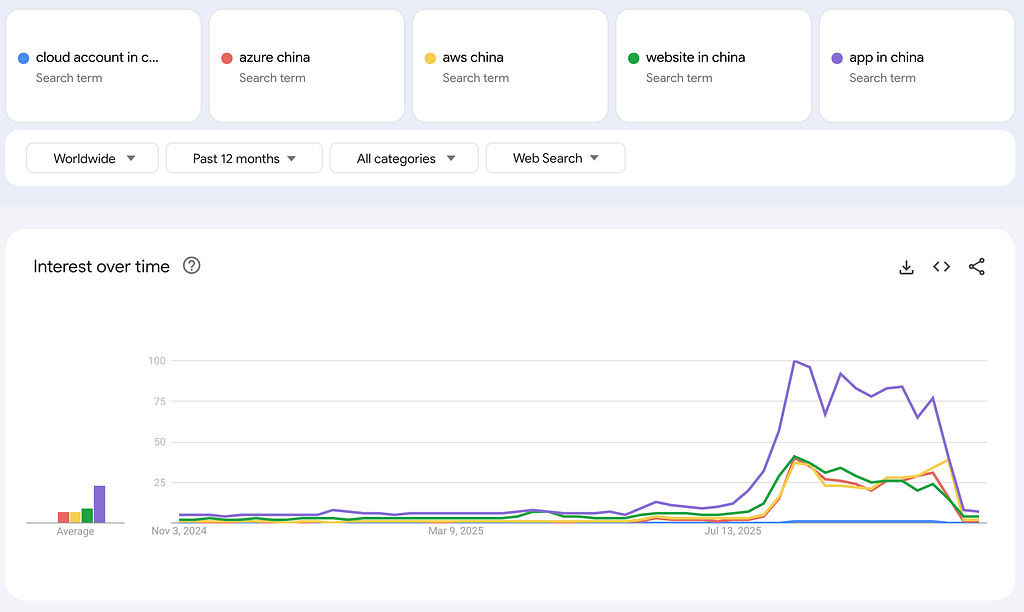
There are a few possible explanations. One is geopolitical: as global companies recalibrate data strategies amid evolving trade tensions and local data laws, hosting inside China has become both a compliance necessity and a competitive advantage. Another could be cost optimization with many organizations are realizing that routing traffic across the Great Firewall isn’t just slow, it’s expensive.
Whatever the reason, the interest in Chinese cloud infrastructure has clearly hit the mainstream.
From “China-Ready” Apps to “China-Ready” Cloud
Earlier this year, I wrote an article (and gave a talk) on how to make your app “China Ready” covering network latency, localization, and compliance with Chinese data laws.
But after the talk, one question kept coming up:
“How do we actually open a cloud account in China?”
That question sounds deceptively simple, but as anyone who’s tried knows, it’s not straightforward. Even for a quick proof of concept (POC), you can’t just sign up and deploy. You’ll need a registered business in China and an ICP license to legally host or serve web traffic inside the country.
The Proper Way: Register a Business + Get an ICP License
If your company is serious about long-term presence in China, the most compliant and stable route is to:
1. Register a legal entity in China (a Wholly Foreign-Owned Enterprise, or WFOE).
This gives you the ability to sign contracts, hire staff, and open a business bank account — all prerequisites for most Chinese cloud providers.
2. Apply for an ICP license (Internet Content Provider license).
This license is required by the Ministry of Industry and Information Technology (MIIT) for hosting any website or app accessible in mainland China.
The process can take a few weeks, and requires your business registration, Chinese contact address, and a local representative.
Once you have both, you can apply for an enterprise cloud account with any of the major providers — Alibaba Cloud, AWS China, Azure China, or Tencent Cloud.
The Practical Way: Partner Through a Local Service Provider
For teams that just want to test their product or deploy a limited internal environment, registering a company in China might be overkill.
That’s where service partners come in. They’re licensed to hold ICPs and cloud resources on behalf of foreign clients. Through them, you can:
- Get access to Chinese cloud infrastructure without forming a legal entity.
- Host and serve web traffic inside China under their ICP.
- Set up your AWS China, Azure China, or Alibaba Cloud accounts in a compliant way.
OpenBind (formerly Great Wall Connect) is one such consultancy that can help bridge the legal and operational gap for you, making it possible to go live inside the Great Firewall while staying compliant with local regulations.
Choosing Your Cloud: AWS, Azure, or Alibaba Cloud
Cloud operators in China are completely isolated from their Global counterparts, which means you would need a separate account to run them. While AWS and Azure provide their services via their partners in China, local clouds platforms like Alibaba, Tencent or Huawei have a better suite of more localized services and have more trust of the Chinese consumers.
Let’s break down what to expect from each:
- AWS China (Beijing & Ningxia regions) — Operated by Sinnet and NWCD respectively. The environment is isolated from global AWS, meaning separate accounts, endpoints, and credentials. The services available in each region are different from each other, as well as different from the global AWS.
- Azure China — Run by 21Vianet. The interface and services are familiar, but again, completely separated from global Azure for compliance reasons.
- Alibaba Cloud — The most mature local player with strong native integrations, but documentation can sometimes lag for English users.
- Tencent Cloud — Excels for gaming and Superapp/Miniapp ecosystem with strong infrastructure for running low-latency apps.
Each provider has its own quirks and approval flow. Opening the account through OpenBind can streamline these, as they already work with the in-country operators.
The Bottom Line
The spike in searches for “cloud account in China” isn’t just a curiosity — it’s a reflection of a growing realization:
You can’t build a serious digital presence in China without going local.
Whether you go the official route (business + ICP) or work with a licensed partner like OpenBind, the key is to start early, plan your compliance, and pick the right cloud for your use case.
In 2025, being “China Ready” means being cloud-ready for China.